
Saving the Lesser Prairie Chicken
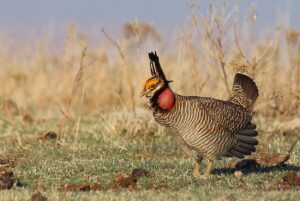
A recent partnership involving the New Mexico Land Conservancy, the New Mexico State Land Office, renewable energy company NextEra Energy, and local ranchers is throwing the bird a crucial lifeline: protection of over 22,229 acres (with more in progress) of critical habitat. This initiative, which balances conservation and habitat restoration with responsible land use, provides a promising model for protecting species on the brink of extinction.
Current estimates are that only 38,000 lesser prairie chickens remain within a five-state range including portions of Kansas, Oklahoma, Colorado, Texas, and a small and shrinking portion of eastern New Mexico—habitat that also coincides with the prime wind corridor blowing through our state from the northeast to southwest.
Lesser Prairie Chicken populations have historically experienced boom-bust cycles, but by 2016 their populations dipped below their ability to recover in healthy numbers. The birds were listed as a federally “threatened” species under the Endangered Species Act (ESA) at that time, but recently delisted by court order in August.
Fragmentation of rangelands is of particular concern, which has caused individual communities to become isolated. New roads, utility lines, and residential development all have negative impacts on the prairie chicken’s ability to sustain healthy populations, but wind energy development can be especially problematic for the birds. Prairie chickens demonstrate a strong aversion to vertical structures, and won’t nest near anything that researchers believe represents a tree, or anything that might attract perching raptors.
When NextEra Energy first developed plans to construct the Crossroads-Hobbs-Roadrunner transmission line to deliver electricity produced by wind farms to communities across the West, they recognized they would need to offset any impacts to the lesser prairie chicken with a strategy to help the bird survive and thrive.
At the behest of the State Land office, NextEra began collaboration with the New Mexico Land Conservancy and Riverbank Conservation to improve and protect state and private ranchland critical to the bird’s survival. Building on a collaborative effort in 2019 to establish a ‘conservation bank’ for the lesser prairie chicken, NMLC and Riverbank worked with ranchers near Milnesand to establish conservation protections that ensure this important habitat is never converted to land uses that will negatively affect the bird. Riverbank even worked with local landowners to remove existing vertical structures that deter lesser prairie chickens from nesting and mating.
When coupled with conservation protections on adjacent state trust lands, this project has resulted in the protection and restoration of over 22,000 (with another 5,000 in progress) contiguous acres of habitat suitable for the prairie chicken’s survival: more than five times the amount of land that was affected by NextEra’s transmission line.